Mxr M169 Carbon Copy Analog Delay Guitar Pedal User Manual
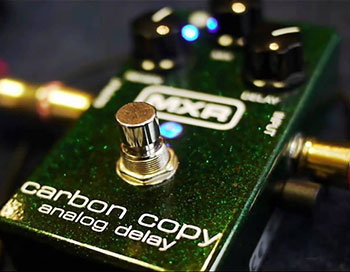
The MXR Carbon Copy Analog Delay first hit pedalboards in 2008, captivating guitar players the world over with its rich bucket-brigade warmth and elegant simplicity. Today, it’s the go-to standard for players who want a well-rounded, easy-to-use delay pedal that sounds incredible.
Jan 01, 2014 This is the MXR Carbon Copy Analog Delay Pedal. Go from crisp 'bathroom' slap echoes to epic, Gilmouresque delays with the MXR Carbon Copy Analog Delay. Featuring 600ms of delay time with optional. The MXR Carbon Copy pedal is the ultimate in rich warm delay because of its completely analog signal path. The Carbon Copy features 600ms of delay time with optional modulation all in a pedal no larger than the Phase 90. The modulation is controlled by a top mounted switch and there are three knobs for ease of use. Page 1 M169 CARBON COPY ANALOG DELAY ® 7revD.; Page 2. Run a cable from your guitar. Rotate the MIX knob clockwise Input Impedance 1 MΩ. 100% analog bucket- The MXR Carbon Copy Analog to the Carbon Copy’s INPUT to increase the ratio of wet to Output Impedance 1 kΩ.

Since then, the Carbon Copy name has practically developed into a sub-brand of its own. In 2015, we released the Carbon Copy Bright Analog Delay, a limited edition pedal that gave players all the functionality of the original but with a brighter sound. In 2017, we released the Carbon Copy Deluxe Analog Delay for those players who love the sound and user-interface of the original but want to exercise more control over their Carbon Copy Delay experience with more options for tone and performance. The year 2019 sees another join the fold in the form of the Carbon Copy Mini Analog Delay. It’s a must-have for players who need more freedom over their pedalboard real estate.
That makes three Carbon Copy Delays currently on offer, so you might be wondering which one is right for your needs as a player.
Let’s find out.
The one that started it all, the original Carbon Copy Analog Delay is for players who want to plug in and play without any option anxiety on or off of a pedalboard. Just use the three external controls set delay time, the number of repeats, and the mix of wet and dry signals, and if you want to add some tape echo warble or shimmery chorusing to your repeats, just hit the Mod switch. You can tweak the speed and width of the modulation circuit by accessing the internal controls if you’re so inclined—just remove the bottom plate—otherwise, all you need to bother with are the three knobs on the front of the pedal. Finally, the M169 runs on battery as well as AC power if you’re a player who likes a more freestyle setup.
Subaru XV Subaru demonstrated the Subaru XV concept vehicle in 2011. The XV is sold as the Subaru XV Crosstrek and was unveiled at the 2012 New York International Auto Show. Get notified for new files? We'll send you a quick email when a new Subaru XV document is added. Subaru XV 2013 Workshop Manual Crosstrek (405 Pages) (Free) Related. 2013 Subaru XV Crosstrek - Owner's Manual (464 pages) Posted on 2 Feb, 2016 by Weiner. Model: 2013 Subaru XV Crosstrek. 2015 subaru xv crosstrek manual. Subaru is committed to the safety and protection of our drivers and the ones they love. As part of that commitment, we've made it easy to learn more about the Takata airbag inflator recall — the largest recall in automotive history, currently affecting vehicles across the industry — and how your Subaru may be impacted. Check Your Vehicle.
Lg wm2487hwm download manual. SteamFresh Cycle.
The Carbon Copy Deluxe Analog Delay is for players who want more control over the tone and texture of their repeats as well as more freedom in the studio. It takes the warm bucket-brigade delay and cool modulation of the M169 and adds several features for the players who want to take their time to get down and dirty with their delay signal. First, the M292 boasts a tap tempo switch that unlocks a full 1.2 seconds of delay potential so that you can play everything from tight slap-back notes to moody, spatial soundscapes while syncing up the rhythm of the repeats to whatever song you’re playing. On top of that, the Tap Division switch, accompanied by an easy-to-read status display, gives you four different subdivisions: dotted 8ths, 8ths, triplets, and 16ths.
Now, let’s talk tone. As mentioned, the M292 features the same modulation circuit as the M169, but we put the Speed and Width controls on the front of this pedal for players who like to tweak and experiment rather than set it and forget it. For further tonal versatility, we added a Bright switch, which engages the vibrant articulation of the Carbon Copy Bright Delay circuit. The Mod and the Bright switch both offer a wide range of sounds—just what you need when dialing in the right character for your delay signal.
Mxr Analog Delay
Now for the deep-delvers. First, let’s talk about the expression jack. If you have an expression pedal such as the Dunlop DVP3 Volume (X) Pedal or DVP4 Volume (X) Mini Pedal or an external footswitch such as the MXR Tap Tempo Switch, you can hook it up to the Carbon Copy Deluxe Delay’s expression jack and then program two different configurations for the Delay, Speed, and Width knobs and Bright, Tap Div, and Mod switches. An expression pedal will allow you to blend seamlessly between the two, while an external footswitch will allow you to switch discretely between the two. You can also set up the external switch to control the Bright switch, the Mod switch, the Tap Div switch, and more.
Guitar Center
If you plan on laying down some tracks in the studio, the M292 has a couple of features under the hood to make your life easier. Removing the bottom plate gives you access to the internal Input Gain and Dry switches. The internal Input Gain switch can be used to optimize performance for line-level input signals so that you can plug in to an effects loop. The Dry switch can be used to remove the dry signal from the output mix while the delay effect is on, giving you 100% wet return for recording and parallel signal mixing.
Like the M169, the M292 can run on both AC and battery power.
Finally, we get to the new kid on the block. If you love the elegant simplicity and great sound of the original Carbon Copy Analog Delay, but you’re looking to free up some pedalboard real estate, the Carbon Copy Mini Analog Delay is exactly what you’re looking for.
Like both the M169 and the M292, the M299 is built around warm, bucket-brigade delay tones. It has Regen, Mix, and Delay controls with a Mod switch on the face of the pedal —with Speed and Width controls for the modulation circuit located inside the pedal—just like the M169. Like the M292, this pedal features a Bright switch on the side of the pedal for players who want that extra tonal variety.
Best Analog Delay
The Carbon Copy Mini Analog Delay adds another set of delay solutions to the Carbon Copy line. At a time when pedalboard space comes at a premium, the M299 will make the most of its little footprint.